
About Cohort
What is Cohort
Cohort is a structured analytics environment for understanding audience behavior, built on your organization’s data and surfaced through Tableau.
It provides a flexible space for teams to explore data, build visualizations, and answer questions as they emerge. Rather than relying on static reports, Cohort supports ongoing analysis, where insights are developed through exploration.
The system is built around a structured data model, a consistent set of definitions, and a framework for working with audience data over time.
Approach
Most organizations already have the data they need. The challenge is not access, it is how that data is structured, explored, and applied.
Cohort is designed around a different approach to analysis. Instead of producing one-time reports, it creates an environment where teams can continuously ask questions, test assumptions, and refine their understanding of audience behavior.
This means focusing less on outputs and more on process. Analysis becomes something teams do regularly, not something they receive.
How It Works
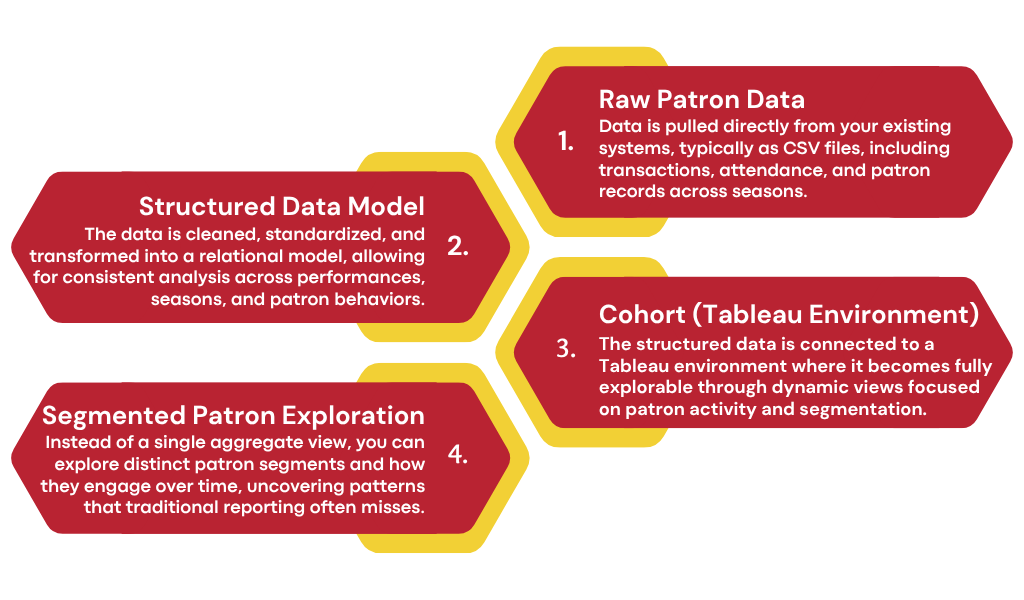
Cohort transforms raw patron data into a structured, explorable environment designed to reveal how audiences actually behave over time.
Here’s how that process works:
Why It Exists
Cohort was developed in response to a common gap. Organizations often invest in collecting data, but lack a clear way to work with it in a meaningful, ongoing way.
Reporting systems tend to prioritize summaries and snapshots. While useful, they often miss the complexity of how audiences actually behave over time.
Cohort is designed to address that gap by providing a way to explore patterns, understand behavior, and connect insights to decisions.
About Tehvon
Tehvon Fowler-Chapman has worked across the performing arts, with experience ranging from educator to executive administrator. He used this experience to create Cohort,
He has held roles with organizations including Washington Concert Opera, Wolf Trap Foundation for the Performing Arts, and Los Angeles Opera. His work has spanned education, operations, executive administration, and research.
Most recently, he worked with the Advisory Board for the Arts, advising 25 arts organizations across the country on data, strategy, audience engagement, and research.
Across this work, a consistent pattern emerged: organizations had access to large amounts of data, but lacked a clear system for exploring it in a meaningful and ongoing way.
Cohort was developed as a response to that gap, combining a structured data model, an analytical framework, and a flexible environment for exploration.